basic stoichiometry phet lab answer key pdf
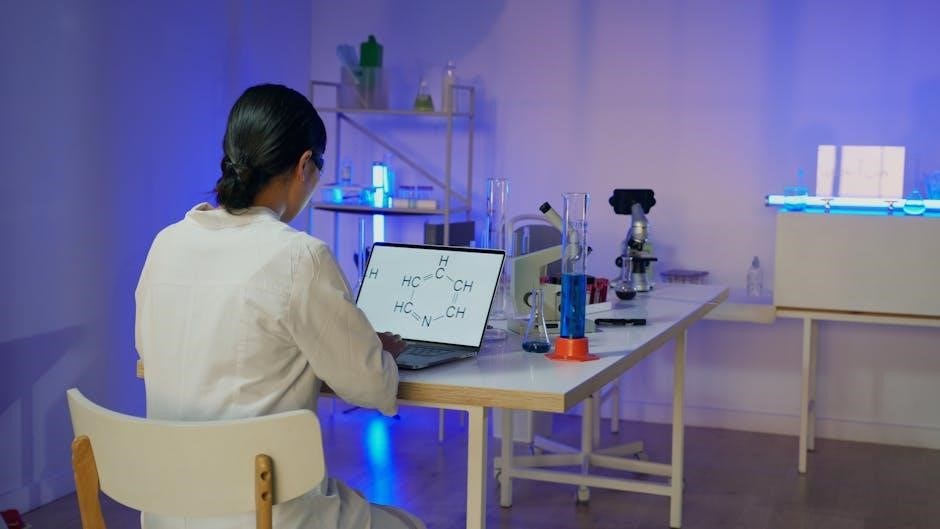
Basic Stoichiometry PhET Lab: Article Plan
This article details utilizing the PhET simulation for stoichiometry, focusing on balancing equations, mole ratios, and limiting reactants, with readily available online resources and answer keys.
Stoichiometry is the cornerstone of quantitative chemistry, dealing with the proportional relationships between reactants and products in chemical reactions. Mastering these concepts can be challenging for students, often requiring a strong visualization of molecular interactions. This is where the PhET Interactive Simulations, specifically the “Basic Stoichiometry” lab, proves invaluable.
The PhET simulation offers a dynamic, interactive environment to explore these abstract ideas. Students can manipulate quantities of reactants, observe the resulting product formation, and gain intuitive understanding of concepts like limiting reactants and excess reactants. This lab isn’t just about calculations; it’s about building a conceptual foundation. Finding a reliable basic stoichiometry PhET lab answer key PDF can further enhance the learning experience, providing a benchmark for understanding and problem-solving.
This article will guide you through leveraging the PhET simulation to solidify your grasp of stoichiometry, alongside resources for finding helpful answer keys.
What is Stoichiometry?
Stoichiometry, at its core, is the study of the quantitative relationships between reactants and products in chemical reactions. It’s about understanding how much of each substance is involved, allowing us to predict yields and optimize chemical processes. This involves using balanced chemical equations as a roadmap, interpreting coefficients as mole ratios.
Essentially, stoichiometry allows chemists to translate macroscopic measurements (grams, liters) into microscopic understanding (moles, molecules). A solid grasp of molar mass and the mole concept is crucial. While calculations are key, true understanding requires visualizing the reaction at a molecular level. Resources like a basic stoichiometry PhET lab answer key PDF can aid in verifying calculations and reinforcing conceptual understanding.
The PhET simulation provides this visualization, making stoichiometry more accessible and less abstract.
The Role of the PhET Interactive Simulation
The PhET Interactive Simulation offers a dynamic and visual approach to learning stoichiometry, moving beyond static textbook examples. It allows students to manipulate variables – reactant amounts – and observe the resulting changes in product formation in real-time. This interactive environment fosters a deeper conceptual understanding, particularly for challenging concepts like limiting reactants and excess reactants.
Unlike traditional problem-solving, PhET encourages exploration and experimentation. Students can ‘build’ molecules and ‘run’ reactions, solidifying their grasp of mole ratios and balanced equations. Accessing a basic stoichiometry PhET lab answer key PDF can be beneficial for checking work, but the true value lies in the simulation’s ability to promote active learning and conceptual clarity. It’s a powerful tool for visualizing abstract chemical principles.

Understanding Balanced Chemical Equations
Balanced equations are fundamental to stoichiometry; the PhET simulation visually reinforces this, aiding students in mastering equation balancing and reaction predictions.
Importance of Balancing Equations
Balancing chemical equations is paramount in stoichiometry because it upholds the law of conservation of mass – matter isn’t created or destroyed in chemical reactions. An unbalanced equation doesn’t accurately represent the quantitative relationships between reactants and products. This directly impacts calculations of mole ratios, limiting reactants, and ultimately, predicted product yields.
The PhET simulation excels at demonstrating why balancing is crucial. Students can visually observe how an unbalanced equation leads to ‘leftover’ reactants or a deficiency in product formation. Correctly balanced equations provide the precise stoichiometric coefficients needed for accurate calculations. Without this foundation, determining the correct amounts of reactants needed, or the maximum amount of product achievable, becomes impossible. The simulation’s interactive nature reinforces this concept effectively, preparing students for more complex stoichiometric problems.
How to Balance Chemical Equations – A Review
Balancing equations involves adjusting coefficients – not subscripts – to ensure the same number of each atom appears on both sides of the equation. A systematic approach is best: start by listing the number of atoms of each element in reactants and products. Then, adjust coefficients, often beginning with polyatomic ions if present, to equalize the atom counts.
Trial and error is common, but strategic adjustments minimize it. Remember to re-count atoms after each coefficient change! The PhET simulation provides a fantastic platform to practice this skill. Students can manipulate coefficients and instantly visualize the impact on the reaction. Mastering this skill is foundational for success in stoichiometry, enabling accurate mole ratio calculations and predictions of reaction outcomes. A solid grasp of balancing is key before tackling more complex problems.
Using the PhET Lab to Practice Balancing
The PhET “Balancing Chemical Equations” simulation offers an interactive environment to hone balancing skills. Students can select from various equations, adjusting coefficients using sliders or direct input. The simulation visually represents molecules, making it easier to understand the concept of conservation of mass. It provides immediate feedback, indicating whether an equation is balanced or not, and highlighting imbalances.
This visual approach is particularly helpful for learners who struggle with abstract concepts. The lab encourages experimentation and reinforces the understanding that balancing isn’t about changing the chemical formula, but about adjusting the amount of each substance. Utilizing the simulation alongside practice problems and an answer key builds confidence and solidifies understanding.
Moles, Molar Mass, and Mole Ratios
Understanding these concepts is crucial for stoichiometric calculations; the PhET simulation visually demonstrates their relationships within chemical reactions, aiding comprehension.
Defining the Mole Concept
The mole is a fundamental unit in chemistry, representing a specific number of particles – 6.022 x 10²³, known as Avogadro’s number. This quantity allows us to relate macroscopic measurements (like grams) to the microscopic world of atoms and molecules.
Essentially, the mole provides a convenient way to count atoms and molecules, which are far too small to count individually. The PhET simulation helps visualize this abstract concept by allowing students to manipulate quantities of reactants and observe the resulting changes in product formation.
Understanding the mole is paramount for performing stoichiometric calculations, as it forms the bridge between mass, moles, and the balanced chemical equation. It’s the cornerstone for determining reactant and product amounts in chemical reactions, and the simulation reinforces this vital connection.
Calculating Molar Mass
Molar mass is the mass of one mole of a substance, expressed in grams per mole (g/mol). It’s determined by summing the atomic masses of all atoms in a chemical formula, obtained from the periodic table. For example, water (H2O) has a molar mass of approximately 18.015 g/mol (2 x 1.008 + 16.00).
Accurate molar mass calculation is crucial for converting between mass and moles, a key step in stoichiometric problems. The PhET simulation doesn’t directly calculate molar mass, but understanding this concept is essential for interpreting the simulation’s results.
Students must correctly determine molar masses to predict reactant and product amounts, and to verify the simulation’s outcomes. Mastering this skill builds a strong foundation for more complex chemical calculations.
Determining Mole Ratios from Balanced Equations
Balanced chemical equations are fundamental to stoichiometry, revealing the quantitative relationships between reactants and products. The coefficients in a balanced equation represent the mole ratio – the relative number of moles of each substance involved in the reaction.
For instance, in the equation 2H2 + O2 → 2H2O, the mole ratio of H2 to H2O is 2:2 (or 1:1). The PhET simulation visually demonstrates these ratios as you adjust reactant quantities and observe product formation.
Understanding mole ratios allows for predicting how much product will be formed from a given amount of reactant, a core skill reinforced by the lab. Correctly identifying these ratios is vital for accurate stoichiometric calculations.

Limiting Reactants and Excess Reactants
The PhET lab helps identify limiting reactants – those fully consumed – and excess reactants, left over after the reaction completes, impacting product yield.
Identifying the Limiting Reactant
Determining the limiting reactant is crucial for predicting product formation. This reactant dictates the maximum amount of product achievable, as the reaction stops when it’s entirely consumed. The PhET simulation visually demonstrates this concept; by adjusting reactant quantities, students observe which reactant vanishes first.
Reaction tables within the lab aid in this identification. By tracking the moles of each reactant and comparing them to the stoichiometric coefficients from the balanced equation, the limiting reactant becomes apparent. The reactant producing the fewest moles of product, relative to its coefficient, is the limiting one. Understanding this concept is fundamental to accurate stoichiometric calculations and maximizing product yield in chemical reactions. The answer key provides guidance on correctly identifying these reactants.
Calculating the Amount of Product Formed
Once the limiting reactant is identified, calculating the theoretical product yield becomes straightforward. This involves using the mole ratio derived from the balanced chemical equation. The PhET simulation allows students to manipulate reactant amounts and directly observe the corresponding product formed, reinforcing this calculation.

Students convert moles of the limiting reactant to moles of product using the stoichiometric ratio, then potentially convert moles of product to grams using molar mass. The lab’s reaction tables facilitate tracking these conversions. The answer key provides step-by-step solutions, ensuring accurate calculations and a solid grasp of the relationship between reactant quantities and product formation. Mastering this skill is vital for predicting reaction outcomes.
Using Reaction Tables in the PhET Lab
The PhET simulation’s reaction tables are central to understanding stoichiometry. These tables visually represent the number of molecules of reactants and products, allowing students to track changes during a reaction. By adjusting initial amounts, students observe how the limiting reactant dictates the maximum product formed.
The answer key often references specific table entries to demonstrate correct calculations and identify errors. Students learn to populate the table based on the balanced equation, determine the limiting reactant by observing complete consumption, and then calculate product yield. Utilizing these tables effectively is key to mastering stoichiometric concepts and accurately predicting reaction outcomes within the simulation environment.

PhET Lab Specifics & Answer Key Focus
This section guides students through the PhET lab activities, highlighting common pitfalls and providing access to the answer key for accurate results.
Overview of the Basic Stoichiometry PhET Lab Activities
The Basic Stoichiometry PhET Lab is designed to reinforce core chemical concepts through interactive exploration. Students begin by visually balancing chemical equations, manipulating coefficients to satisfy the law of conservation of mass. The simulation then progresses to the mole concept, allowing learners to ‘build’ molecules and observe their mass relationships.
A key component involves identifying limiting and excess reactants. Students use reaction tables within the PhET environment to determine the maximum amount of product formed, given specific reactant quantities. This hands-on approach fosters a deeper understanding than traditional textbook exercises. The lab culminates in analyzing data and applying stoichiometric principles to predict reaction outcomes. Online resources, including readily available answer keys, support student learning and self-assessment throughout the process.
Common Challenges and Troubleshooting
Students often struggle with conceptually grasping mole ratios and their direct link to balanced equations within the PhET simulation. A frequent issue is incorrectly identifying the limiting reactant, leading to inaccurate product yield calculations. Visualizing the ‘building’ of molecules can be challenging for some, requiring careful attention to atomic counts.
Troubleshooting typically involves revisiting the balancing equation fundamentals and ensuring correct molar mass calculations. When discrepancies arise, encourage students to double-check their work against the provided answer key. Common errors include misinterpreting the simulation’s visual cues or overlooking stoichiometric coefficients. Utilizing the step-by-step instructions and seeking clarification on confusing aspects can significantly improve understanding and accuracy.
Where to Find the Answer Key (and What to Expect)
The Basic Stoichiometry PhET Lab answer key is typically accessible through your instructor, often posted on the course’s learning management system (like Canvas or Blackboard). Many educators also provide direct links to downloadable PDF versions of the answer key. Online searches using specific keywords – “Basic Stoichiometry PhET Lab answer key PDF” – can yield results, but verify the source’s credibility.
Expect the answer key to provide detailed solutions for each activity, including balanced equations, limiting reactant identification, product yield calculations, and completed reaction tables. It should offer step-by-step explanations, not just final answers, to facilitate learning. Remember, the key is a learning tool; use it to understand how to solve problems, not just to copy answers.

Analyzing Results and Improving Understanding
Compare simulation results with the answer key to pinpoint errors and strengthen comprehension of stoichiometry concepts, enhancing problem-solving skills and real-world applications.

Interpreting Data from the Simulation
Effectively utilizing the PhET simulation requires careful data interpretation. Students should meticulously record reactant quantities and product formations for each reaction tested. Comparing these observed results against predicted values – ideally verified using the answer key – reveals discrepancies and highlights areas needing further investigation.
Pay close attention to the visual representations within the simulation; the number of molecules directly corresponds to mole ratios established by the balanced chemical equation. Analyze how changing reactant amounts impacts product yield, identifying limiting reactants and excess reagents. The simulation’s reaction tables provide a structured format for organizing data, facilitating clear comparisons and calculations.
Cross-referencing simulation outcomes with the answer key isn’t simply about finding the “right” answer; it’s about understanding why a particular result was obtained, solidifying the connection between theoretical stoichiometry and practical application.
Applying Stoichiometry to Real-World Problems
Stoichiometry isn’t confined to the lab; it’s fundamental to numerous real-world applications. Understanding mole ratios and limiting reactants is crucial in industries like pharmaceuticals, manufacturing, and environmental science. For example, optimizing fertilizer production requires precise stoichiometric calculations to maximize yield while minimizing waste.
Consider industrial chemical synthesis – accurately determining reactant quantities prevents costly errors and ensures efficient production. Even everyday tasks, like baking, rely on stoichiometric principles; altering ingredient ratios impacts the final product.

The skills honed through the PhET simulation, and reinforced by referencing the answer key, translate directly to these practical scenarios. By mastering these concepts, students develop a powerful problem-solving toolkit applicable far beyond the chemistry classroom, enabling informed decision-making in diverse fields.
Further Resources for Stoichiometry Practice
Beyond the PhET simulation and its associated answer key, numerous resources bolster stoichiometry understanding. Khan Academy offers comprehensive video tutorials and practice exercises covering all aspects of the topic, from balancing equations to limiting reactant calculations.
Chemistry LibreTexts provides detailed textual explanations and worked examples, catering to different learning styles. Several websites offer stoichiometry practice worksheets with varying difficulty levels, allowing students to progressively challenge themselves.
Don’t overlook textbook problems and online quizzes! Actively seeking out diverse practice opportunities, alongside reviewing the PhET lab’s answer key for clarification, solidifies comprehension and builds confidence. Mastering stoichiometry requires consistent effort and utilizing a variety of learning tools.